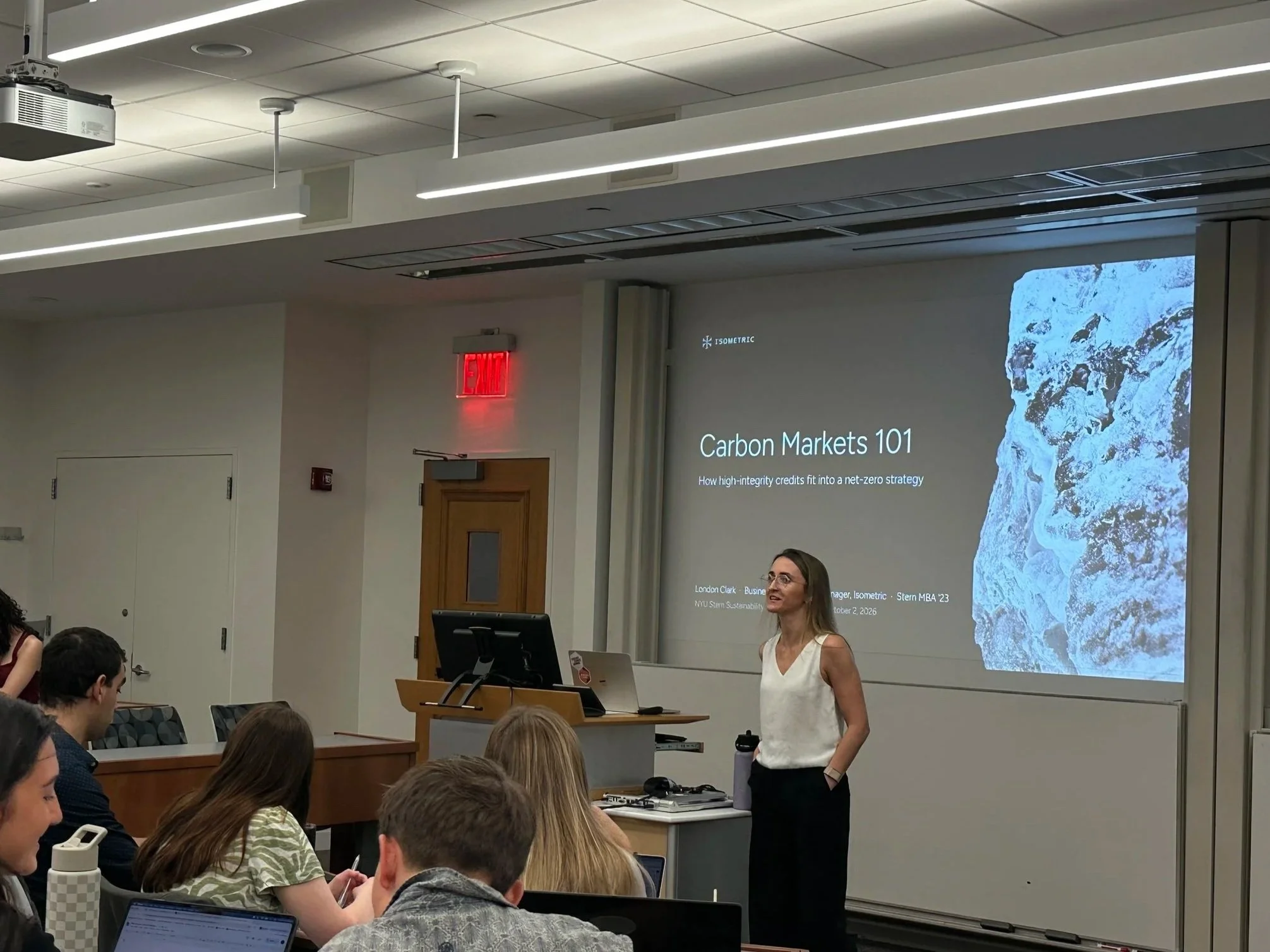
London Clark presents in a Center for Sustainable Business Sustainability Skills Boot Camp
The Stern Center for Sustainable Business invited London Clark (MBA ‘23), Business Development Manager at Isometric to kick off the first Sustainability Skills Boot Camp of the year for a crash course on carbon markets.
In an increasingly warming world, the carbon budget for a 1.5°C warming scenario will be used up in about three years. At this tipping point, the earth will see coral reef dieoffs, extreme heat, and increased natural catastrophes. To avoid this scenario, collective action is required to remove more Carbon Dioxide than is emitted.
What does that mean in practice? Current carbon removal efforts need to quadruple, doubling nature-based solutions by about 2x from 2.2 Gt to roughly 5 Gt. The biggest gap today stands in novel removal methods (ie Direct Air Capture, biochar, Carbon Capture and Storage, etc.), from roughly 2 Mt to 3.5 Gt+. To avoid a 1.5°C warming scenario, these removal efforts need to occur concurrently with corporate carbon reduction efforts through Scopes 1, 2, and 3. Any removal efforts are currently voluntary, but will be required for large companies by 2035 under the Corporate Net-Zero Standard V2.0. Durable supply within the carbon market is scarce, with demand expected to outpace supply by 2030 as companies compete for removals, so delaying work risks missing out on top tier credits. Focusing on the voluntary carbon market (which makes up ~2% of the broader carbon market), carbon credits are further broken up into avoidance credits (~80%) and removal credits (20%).
Following public scrutiny over credits issued for tonnes that weren’t real, additional or permanent; the market is rebuilding around integrity for high-quality carbon credits. For a credit to be legitimate, it must be able to answer three questions set forth by the Isometric Standard:
Quantification: Did the removal or reduction happen, and is the credit value accurate?
Additionality: Would it have happened without the project?
Durability: How long will the carbon stay out of the atmosphere? (credited only beyond 1,000 years)
From there, 7 main removal and reduction pathways emerge.
Biosphere/nature-based solutions include removal solutions that the earth employs naturally. Forests, soils and mangroves store carbon in living systems, so a project falling in this pathway could be reforestation. With a durability of 100+ years, this could look like planting native trees on degraded land and measuring the growth over time using satellite and remote-sensing data.
Biomass carbon removal & storage uses plants to pull carbon from the atmosphere and locks it away permanently or semipermanently, through decomposition or burning. The durability of biomass carbon removal and storage varies, with biochar projects estimated around 200 years and bio-oil 1,000+ years.
Enhanced weathering uses crushed basalt sprinkled onto farmland to react with rainwater carbon to form dissolved bicarbonate, which rivers wash into the ocean where the carbon is safely stored for thousands of years. This pathway speeds up the naturally occurring breakdown of rocks from thousands of years to a couple of years, bringing with it the cobenefit of healthier soils.
Marine methods use ocean and wastewater alkalinity to lock carbon in seawater through physical or chemical processes. The earth’s oceans are the largest active carbon reservoir, absorbing ~25% to 30% of emissions annually. Solutions include speeding up natural processes that capture carbon and marine carbon dioxide removal projects similar to the ones on land which use electrochemical cells to extract dissolved carbon from seawater and convert it into solid minerals like calcium carbonate.
Direct air capture uses machines to pull carbon from the air and injects it deep underground for storage. The durability is 1,000+ years, but the rollout of this technology is still in its early stages due to high costs ($100-$1,000/ton), low output (.01% of carbon removal capacity needed to meet global climate goals), and challenges with scaling the technology (only 3 plants operating globally).
Mineralization uses minerals to react with carbon to form stable rock. Arca utilizes the rocks left behind at mines and speeds up the naturally occurring process of binding carbon to crushed rock, forming solid carbonate that is durable for thousands of years.
Superpollutants are non-carbon greenhouse gasses like methane and nitrous oxide that trap significantly more heat than carbon, but with shorter life spans. This method is focused on cutting methane and refrigerant emissions, focused on reduction rather than removal.
Building a portfolio can include projects from the listed pathways above, with consideration similar to building a financial portfolio. There are six levers to consider:
What is your claim? Which framework will I follow?
What is your quality floor?
Value-chain alignment - are there projects in your sourcing regions/sector?
What is your mix: reductions vs removals, nature vs engineered, short vs long durability?
Geography & co-benefits: where you operate and source; community and biodiversity outcomes?
Price & delivery risk: blended $/t, spot vs multi-year offtake, issued vs future credits?
With ever-evolving regulatory protocols around carbon markets, the VCM is looking at growth over the next five years as companies prepare for removal requirements on the horizon. Supply is finite, and to procure high-quality carbon credits, firms do not have the luxury of time. Developing relationships with suppliers, adjusting the supply chain, and auditing operational emissions all take time, and taking action before the rush as 2030 nears will allow firms access to top tier credits prior to their competitors.
Sustainability Skills Boot Camp #2: 11/20, 1-4 pm
Understanding how regulatory shifts and trends are expected to impact a company’s operations and/or financials can be invaluable. The mechanisms by which a new or amended rule will change strategic incentives or business costs are a competitive advantage. This workshop, led by industry experts at Silver Regulatory Associates, will look at how policy and regulatory changes can impact corporate behavior, from disclosure obligations to process changes, and stakeholder engagement.